> For the complete documentation index, see [llms.txt](https://docs.million-moves.net/start/llms.txt). Markdown versions of documentation pages are available by appending `.md` to page URLs; this page is available as [Markdown](https://docs.million-moves.net/start/learn-the-indicators/million-moves-algo/order-blocks.md).
# Order Blocks
Discover the Power of Order Blocks with Million Moves Algo
The **Order Blocks** feature in the Million Moves Algo is a helpful tool for your trading. You can turn it on or off in the settings.

When it's on, it adds market structure labels to your chart - in the trading world it's often referred to as Smart Money Concept, but it's just a fancy description of Support and Resistance. These labels are like signs that show things happening with the market.
🔒 **Support and Resistance:** Key elements are "Support Orderblock" and "Resistance Orderblock." Support Orderblock acts as a safety net, holding the price up. If it falls below, it may continue dropping. Resistance Orderblock acts as a barrier at the top. Price needs to push through for the trend to continue. If not, the trend might reverse.
🚀 **Structure Breaks:** Look for "Structure Break" labels. Green indicates a potential upward move, while red suggests a possible downward trend. These labels signal shifts in market structure, like transitioning from up to down.
🔥 **Breaker Block = Challenge:** There's also the "breaker block" label. It's like a challenge for the price to overcome before moving ahead. It's a point that needs to be cleared for the trend to proceed.
### Avoid False Signals: Verify Orderblocks
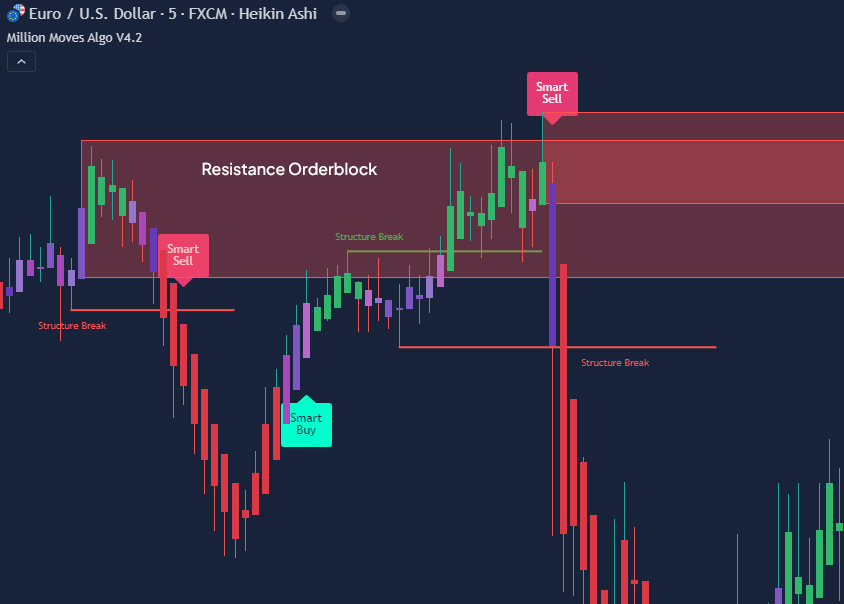
It might not be the smartest move to enter long here. See below why.
☝️ Let's take a look at the 5-minute EUR/USD chart as an example. Even though there was a Smart Buy signal and a long structure break, it was better to wait for a strong body closure above the Resistance Order block. The sellers stepped in after reaching the Resistance Orderblock, they could not continue the long push and it gave us a good opportunity for a short entry.
### Mastering Precise Entries with Orderblocks
**Short entry example**
In the animated example below, notice the red Resistance Orderblock at the top. The price goes up and dives into it, gets pushed back twice, and then falls down giving us a short entry. [👇](https://emojipedia.org/emoji/%F0%9F%91%87)
***
**Long entry example**\
Same for long: Similarly, the price can also bounce off a support order block at the bottom, and this can lead to a change from a short position to a long one. The animation below showcases how effectively you can use the support order block to take a long position. [👇](https://emojipedia.org/emoji/%F0%9F%91%87)
### Use Order Blocks as Visual Clues and Smarter Trading
Using the "Display Order Blocks" feature, you can spot important market changes, find support and resistance points, and understand the strength of barriers. This makes your trading decisions smarter and better.
orderblock.gif?alt=media&token=4a80edd7-f4db-4a09-81d2-98e3a2cb2e5a)
long.gif?alt=media&token=7926a255-c67a-41bc-9203-43565a894ffc)